

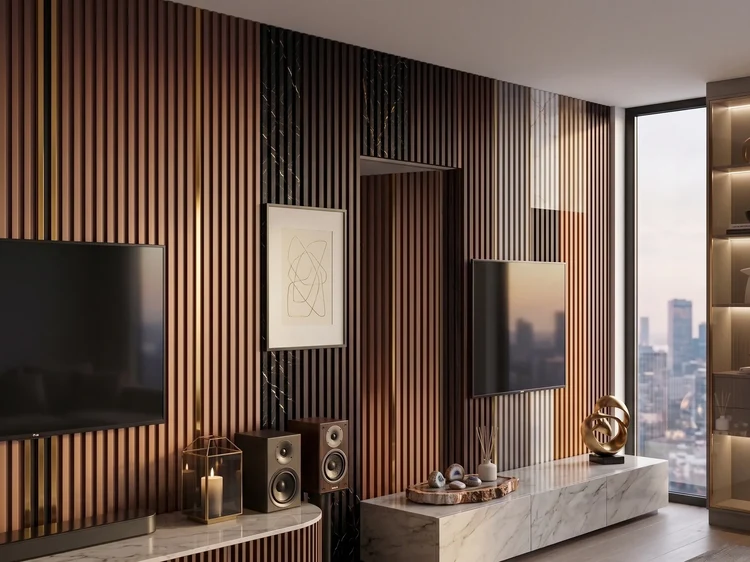
Two wood-look grooved wall panels can sit side by side in a showroom and look nearly identical. Only one of them is actually built to quiet a room down.
That mix-up trips up a lot of buyers searching for the best acoustic wall panels for modern interiors. The grooved, textured look that reads as “acoustic” in people’s minds is really a design language, not a guarantee of performance. Knowing the difference before buying is what actually determines whether a feature wall just looks calm or genuinely sounds calmer too.
Fluted and Slat Panels Aren’t the Same Thing
This distinction matters more than the finish color ever will.
Slat panels are built from individual strips mounted with visible gaps between them, over a felt or backing. Those gaps are deliberate. They let sound pass through to the absorptive material behind, which is where the actual noise reduction happens. Fluted panels are different. They’re a continuous surface with grooves or ridges pressed into it, no gaps, no felt backer behind them, built as one solid textured piece.
That construction difference is the whole story. Fluted panels can offer mild sound diffusion; their grooved surface breaks up a flat reflection instead of bouncing sound straight back, but without an absorptive backer, they’re not pulling sound energy out of the room the way a genuine acoustic panel does. They’re a design product first, with a secondary acoustic benefit, not the other way around.
What WPC Fluted Panels Are Actually Built For
None of that makes fluted panels the wrong choice. It just means they’re solving a different problem than echo control.
WPC (wood-plastic composite) construction gives these panels real advantages over solid wood: resistance to warping, moisture tolerance that natural timber doesn’t have, and a hollow build that keeps the panel lighter without sacrificing the dimensional, three-dimensional look that makes a wall feel finished rather than flat. That’s exactly why fluted panels work so well as:
- A feature wall where texture and tone matter more than echo control
- Reception areas and retail spaces built for visual impact
- Accent walls behind furniture, headboards, or TV units
- Spaces where moisture resistance matters more than sound absorption, like bathrooms or basements
When to Choose Fluted vs. the Dedicated Acoustic Line
Here’s the honest version of this decision, not the version that just tries to sell whichever panel is in front of you.
If the goal is purely visual, a textured, dimensional wall that reads as modern and intentional, fluted panels do exactly that job, and do it well. If the actual problem is an echoey room, a home office picking up too much reverb on video calls, a living room where conversations bounce, the felt-backed acoustic panel line is the one actually engineered to pull sound out of the air, not just redirect it.
It’s not about one panel being better than the other. It’s about matching the panel to what the room actually needs, visual texture or genuine sound absorption, instead of assuming a grooved surface automatically delivers both.
Canada Plastics
This is exactly why Canada Plastics carries both lines separately, rather than blurring them into one marketing pitch.
WPC Fluted Wall Panels come in finishes spanning Metallic Gold, French Oak, Dark Walnut, Mahogany, and Blackwood, giving design-focused buyers genuine range to match a space’s tone. Alongside that, Canada Plastics‘ dedicated Acoustic Wall Panels, felt-backed and purpose-built for sound absorption, cover the rooms where echo is the actual problem being solved. For anyone comparing the best acoustic wall panels for modern interiors against a purely decorative option, having both lines from one supplier means getting an honest answer about which one a specific room actually needs.
FAQ’s
Do fluted panels actually reduce echo in a room?
Only mildly. Their grooved surface diffuses some sound, but without an absorptive backer, they don’t provide genuine sound absorption the way felt-backed acoustic panels do.
What’s the real difference between slat and fluted panels?
Slat panels have gaps exposing an absorptive backer behind them, enabling real sound absorption. Fluted panels are a continuous grooved surface with no backer, built mainly for looks.
Is WPC a durable material for wall panels?
Yes. Wood-plastic composite resists warping and moisture far better than solid wood, making it well-suited to humid or high-traffic spaces.
Should I choose fluted panels for a home office with echo problems?
Not primarily. A felt-backed acoustic panel would address the echo more effectively than a purely decorative fluted panel.
Where can I buy both decorative and acoustic wall panels in Canada?
Canada Plastics offers WPC Fluted Panels for design-focused walls and dedicated felt-backed Acoustic Wall Panels for genuine sound absorption.
Conclusion
A textured wall and a quiet room are two different goals, even when the panels achieving them look almost the same from across the room.
Know which one you’re actually solving for, and the right panel stops being a guess.
That’s the difference between decorating a wall and actually fixing what’s wrong with it.